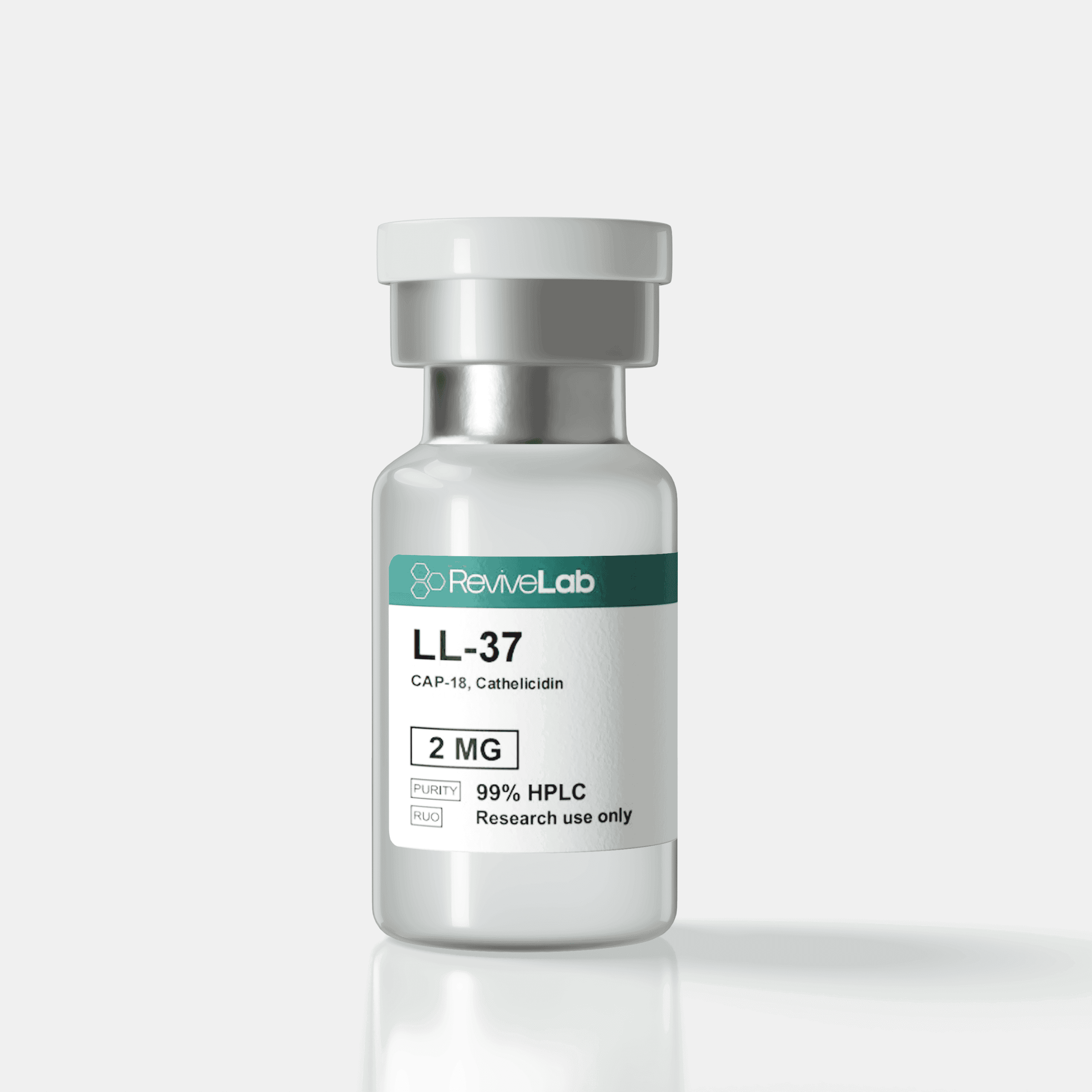
LL-37 is the only known human cathelicidin antimicrobial peptide, derived from the C-terminal segment of hCAP-18, a precursor protein stored in neutrophil granules and secreted by epithelial and immune cells. This 37-amino-acid peptide plays a central role in innate immunity, barrier integrity, and tissue regeneration. LL-37 adopts an amphipathic α-helical conformation that allows it to bind lipid membranes, bacterial wall components, and host cell receptors. Its dual physicochemical and signaling properties enable it to act as both a direct microbicidal molecule and a multifunctional immunomodulator that coordinates the transition from inflammation to repair (Ref. 1).
LL-37 is expressed in the skin, respiratory tract, gut, urinary system, and immune tissues, where it forms part of the first line of defense against infection. Expression is upregulated by inflammatory cytokines, vitamin D3, and pathogen-associated molecular patterns (PAMPs). The peptide’s versatility underpins its interest in microbial resistance, chronic inflammation, regenerative biology, and oncology research.
Broad-Spectrum Antimicrobial Activity
- Potent Antibacterial & Anti-Biofilm Effects: LL-37 is active against an extensive spectrum of Gram-positive (e.g., Staphylococcus aureus, Enterococcus faecalis) and Gram-negative bacteria (Escherichia coli, Pseudomonas aeruginosa, Klebsiella pneumoniae, Salmonella enterica).
Mechanistically, the cationic helix electrostatically attracts the negatively charged bacterial membrane, inserts into the bilayer, and forms transient pores that lead to membrane depolarization, leakage of ions, and cell death. In addition, LL-37 interacts with intracellular targets such as DNA and ribosomes once internalized.
One of LL-37’s defining characteristics is its anti-biofilm capacity. It prevents bacteria from forming sessile communities and can disrupt mature biofilms by interfering with quorum-sensing networks. In Pseudomonas models, LL-37 suppresses las and rhl quorum-sensing circuits, thereby reducing virulence-factor production and increasing antibiotic susceptibility (Ref. 2).
- Antifungal Properties: LL-37 also exerts antifungal activity, notably against Candida albicans. It blocks adhesion to epithelial surfaces, reduces filamentation, and inhibits biofilm development, which are essential virulence mechanisms of Candida (Ref. 3). In epithelial co-culture systems, LL-37 reduces hyphal penetration and tissue damage, highlighting its barrier-protective value in mucosal defense.
- Low Propensity for Resistance:Because LL-37 targets microbial membranes and quorum-sensing pathways rather than single enzymes, microbes rarely evolve stable resistance. Even after repeated sub-lethal exposure, bacteria demonstrate limited ability to modify surface charge or lipid composition sufficiently to evade LL-37’s amphipathic action (Ref. 4). This quality makes LL-37 and its analogs promising research candidates for countering multidrug-resistant organisms.
Antiviral Effects
- Influenza and Enveloped Viruses: LL-37 exhibits broad antiviral activity, especially against enveloped viruses. It binds lipid envelopes, causing structural disruption and aggregation of virions. In influenza A virus (IAV) studies, LL-37 directly inactivated multiple strains in vitro and reduced viral loads and cytokine storms in mouse infection models (Refs. 4, 14, 15). Mechanistically, LL-37 interacts with viral glycoproteins and suppresses hemagglutinin-mediated fusion, limiting entry into host cells.
Beyond influenza, LL-37 has been reported to hinder HIV, respiratory syncytial virus, vaccinia, and herpesviruses, suggesting a conserved antiviral mode of action related to electrostatic membrane interference and host-receptor masking.
- SARS-CoV-2 (COVID-19) Mechanistic Research: In the context of SARS-CoV-2, structural modeling and biochemical assays show LL-37 can bind the receptor-binding domain (RBD) of the spike protein, overlapping the ACE2-binding interface (Ref. 5). This binding may sterically hinder spike-ACE2 interaction and limit viral entry in pseudovirus and epithelial-cell assays. LL-37 also down-regulates pro-inflammatory cytokines induced by the virus, reflecting its immunomodulatory aspect. While these findings are preclinical, they support ongoing investigation into LL-37 analogs as experimental antiviral peptides.
Immunomodulatory & Anti-Inflammatory Roles
- Chemoattraction & Immune Coordination: LL-37 acts as a chemoattractant through the formyl-peptide receptor 2 (FPR2/FPRL1) on neutrophils, monocytes, eosinophils, and T cells (Ref. 6). It promotes directional migration to infection sites, enhances phagocytic readiness, and stimulates chemokine secretion (CXCL8/IL-8, CCL2). In dendritic cells, LL-37 modulates maturation and antigen presentation, bridging innate and adaptive immunity.
- Enhanced Pathogen Clearance: Once immune cells arrive, LL-37 enhances their antimicrobial efficacy. It stimulates oxidative burst in macrophages, promotes NET (neutrophil extracellular trap) formation, and synergizes with reactive oxygen species to immobilize pathogens. This reinforcement of innate effector functions explains the improved clearance seen in infection models (Ref. 7).
- Anti-Inflammatory Balance & Endotoxin Neutralization:LL-37 tempers inflammation by binding and neutralizing LPS and lipoteichoic acid, preventing overactivation of TLR4 and TLR2 pathways (Refs. 7, 8). The result is reduced release of TNF-α, IL-1β, and IL-12, and protection from septic over-response. It also interacts with double-stranded RNA sensors, modulating type-I interferon output. This self-limiting feature distinguishes LL-37 from pro-inflammatory cytokines, allowing efficient pathogen clearance with minimal collateral tissue damage.
Wound Healing & Tissue Repair
- Accelerated Re-Epithelialization: In cutaneous injury, LL-37 expression rises sharply at wound margins. Studies in human skin explants show that LL-37 stimulates keratinocyte migration and proliferation by transactivating the epidermal growth factor receptor (EGFR) and activating FPR2, leading to MAPK/ERK signaling cascades (Refs. 9, 11). In vivo, topical LL-37 accelerates closure of full-thickness wounds, increases granulation tissue, and improves collagen deposition. LL-37 deficiency correlates with delayed healing, as seen in chronic venous ulcers and diabetic wounds.
- Angiogenesis & Vascular Regeneration: LL-37 promotes angiogenesis by directly activating endothelial cells to form tubes and sprouting microvessels. It induces VEGF-A and FGF-2 expression via PI3K/Akt and ERK signaling (Ref. 10). In ischemic-limb and myocardial models, LL-37 enhances capillary density and perfusion, supporting its role in vascular repair and tissue regeneration.
- Barrier Protection & Mucosal Integrity: LL-37 strengthens epithelial barriers in the skin, gut, and respiratory tract by upregulating tight-junction proteins (occludin, claudins, ZO-1) and mitigating oxidative stress. This helps prevent “leaky” barrier conditions associated with inflammation and infection, further underscoring its protective and reparative capacities.
Anticancer & Tumor-Modulating Research
LL-37 exhibits context-dependent behavior in tumor biology.
- Tumor-Suppressive Actions: In colon-cancer models, LL-37 and its derivative FK-16 induce p53-dependent, caspase-independent apoptosis and autophagic cell death (Refs. 12, 13). These effects involve mitochondrial release of AIF (apoptosis-inducing factor) and EndoG, leading to DNA fragmentation without caspase activation. LL-37 treatment suppresses tumor growth in xenografted mice, with increased p53 and BAX/BCL-2 ratio.
- Dual or Pro-Tumorigenic Effects: Conversely, LL-37 may promote proliferation and angiogenesis in certain cancers—such as melanoma, breast, and ovarian carcinoma—through FPR2-mediated ERK signaling and induction of VEGF and MMP-9. This dual role highlights its context-specific signaling: protective in inflammation-driven tumorigenesis, yet potentially pro-angiogenic in some epithelial cancers. Such complexity makes LL-37 a critical molecule for studying host defense-oncogenesis crosstalk.


 Retatrutide