Anxiolytic and Mood-Modulating Effects
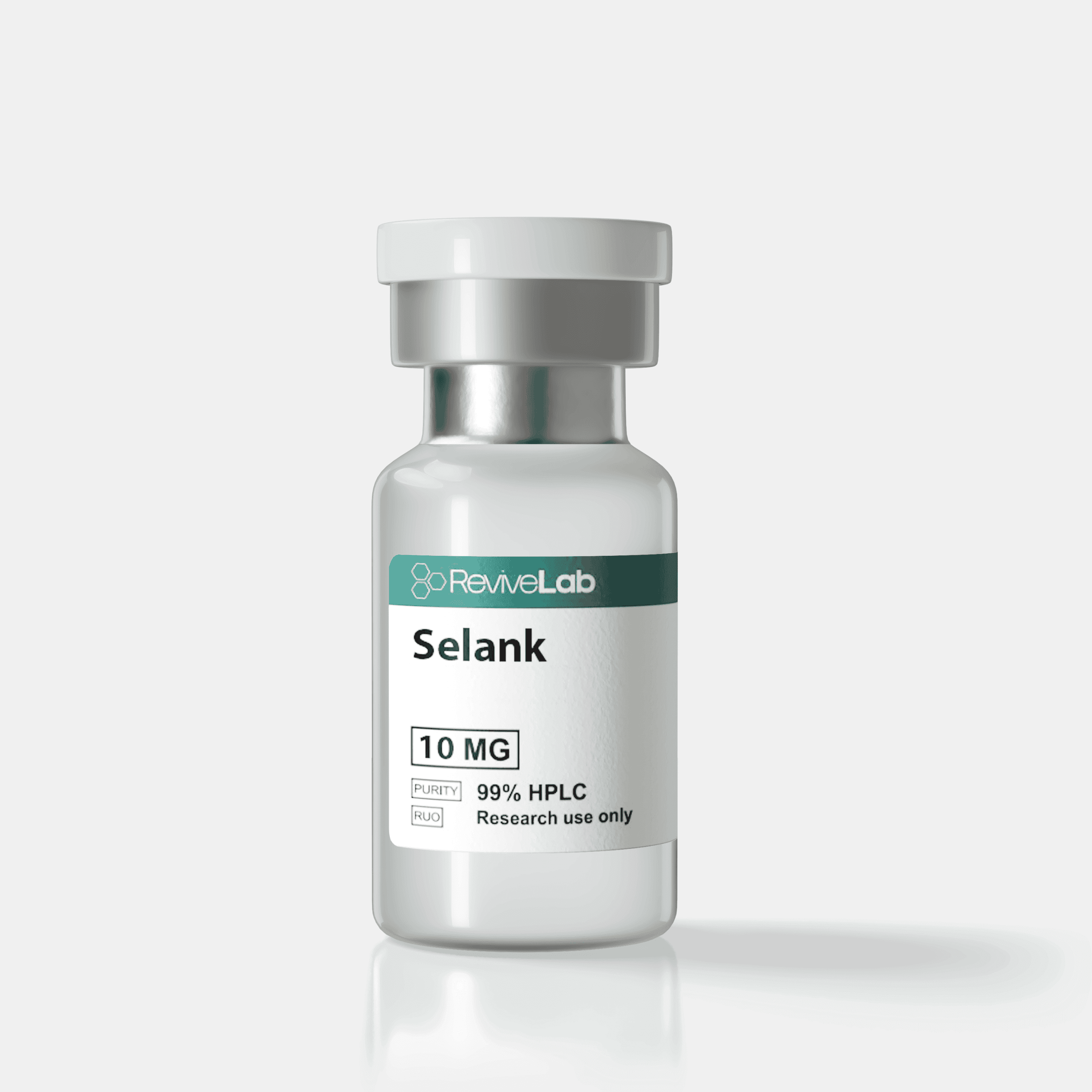
Potent Anxiolytic Activity: Selank is a synthetic heptapeptide analog of the immunomodulatory fragment tuftsin (Thr-Lys-Pro-Arg), engineered by adding a Pro-Gly-Pro sequence to improve stability and systemic activity (Ref. 1). Extensive studies in both animal and human models demonstrate pronounced anxiolytic properties comparable to classical tranquilizers, yet without the sedative or dependence-forming drawbacks.
In controlled clinical trials involving patients with generalized anxiety disorder and neurasthenia, Selank significantly reduced anxiety scores comparable to the benzodiazepine medazepam, but without inducing sedation, withdrawal, or cognitive dulling (Ref. 2). In animal models, Selank administration consistently decreased anxiety-like behaviors in open-field and elevated-plus-maze paradigms (Ref. 6). These findings suggest that Selank acts as a non-sedating anxiolytic modulator capable of normalizing stress-related behavioral patterns.
Anti-Stress & Antidepressant Effects: Selank displays pronounced anti-stress effects across diverse experimental models. In rodents subjected to acute restraint or chronic social stress, Selank abolished fear responses and aggression triggered by stress exposure (Ref. 2). Repeated administration induced antidepressant-like effects in a genetic rat model of depression, eliminating depression-like immobility behavior without altering locomotor activity (Ref. 3).
Mechanistically, these effects are linked to normalization of monoamine levels in key brain regions and modulation of GABAergic and dopaminergic pathways (Ref. 1). Importantly, the antidepressant-like effects of Selank appear to develop cumulatively with repeated dosing, supporting long-term normalization of stress reactivity.
Non-Sedating Profile: Unlike benzodiazepines, Selank’s calming effects occur without sedation, muscle relaxation, or amnesia (Ref. 6). Treated subjects retain normal psychomotor performance and alertness even at elevated doses. Long-term studies revealed no signs of tolerance or dependence, even after prolonged administration (Ref. 2). This pharmacodynamic profile positions Selank as a peptide-based anxiolytic with a broad safety margin and minimal interference with cognitive or motor function.
Cognitive and Nootropic Effects
Enhancement of Learning and Memory: Selank exhibits clear nootropic properties in both animal and human studies. In classical conditioning and passive-avoidance paradigms, Selank accelerated acquisition and retention of learned responses (Ref. 3). Treated animals demonstrated higher rates of correct responses and improved recall accuracy, suggesting facilitation of synaptic plasticity.
The nootropic benefits partly arise from reduction of anxiety-related interference in learning. By normalizing emotional reactivity, Selank allows improved cognitive processing and consolidation of memory traces (Ref. 2). Importantly, these effects occur without psychostimulant-type arousal, maintaining physiological baseline function.
Improved Memory Retrieval: A seven-day Selank regimen in adult rats enhanced novel object recognition performance (p < 0.05 vs. control), indicating superior memory retrieval under non-stress conditions (Ref. 3). These results were accompanied by increased BDNF expression in the hippocampus, a key region for memory encoding and consolidation.
Selank also facilitates retrieval of stored information in stress-impaired or toxin-exposed models. In experiments on alcohol-withdrawal animals, Selank prevented deficits in memory and attention associated with chronic ethanol exposure (Ref. 3). This protective influence highlights its potential for preserving cognitive function during neurochemical imbalance.
Cognitive Resilience Under Stress: Selank enhances cognitive resilience under prolonged or repeated stress exposure. In rodent models of chronic restraint stress and alcohol withdrawal, Selank treatment maintained normal spatial learning and recognition memory while control groups exhibited significant impairment (Ref. 3). The peptide appears to stabilize hippocampal neurochemistry, counteracting stress-induced suppression of neurotrophic factors and monoamine dysregulation.
Collectively, these findings indicate that Selank enhances both baseline cognitive performance and adaptive resilience in challenging environments.
Neuroprotective and Neurotrophic Effects
Neurotrophin Upregulation: Selank has been shown to upregulate brain-derived neurotrophic factor (BDNF), a critical modulator of synaptic plasticity and neuronal survival. Intranasal administration in rats produced a rapid rise in hippocampal BDNF mRNA within three hours and increased BDNF protein content after 24 hours (Ref. 3). BDNF upregulation corresponds with enhanced memory and antidepressant effects, aligning with Selank’s observed behavioral outcomes.
This trophic response suggests that Selank not only modulates neurotransmission but also stimulates structural neuroadaptations conducive to long-term cognitive health.
Protection Against Neural Damage: Selank protects neural tissue from oxidative and metabolic stress. In aged and alcohol-exposed rodents, the peptide prevented neuronal degeneration, preserved dendritic integrity, and mitigated memory decline (Ref. 3). The neuroprotective effects extend to models of chronic stress, where Selank normalized neuronal morphology and reduced hippocampal neuroinflammation.
These findings highlight potential applications in models of neurodegenerative conditions, ischemia, and age-related cognitive decline.
Neurotransmitter Homeostasis: Selank exerts broad homeostatic effects on central neurotransmission. It modulates the balance of serotonin, dopamine, and norepinephrine in limbic and cortical regions (Ref. 2). Experimental data reveal selective increases in cortical serotonin and dopamine turnover under stress conditions, consistent with restored mood and motivation.
Transcriptomic analyses show that Selank alters expression of genes encoding GABA_A receptor subunits, dopamine receptors (DRD1A, DRD2, DRD5), and GABA transporters (SLC6A13) (Ref. 1, 9). This gene-level modulation supports the hypothesis that Selank acts through coordinated regulation of inhibitory and excitatory neurotransmission.
Anti-Inflammatory and Immune-Modulating Activity
Cytokine Regulation: Selank’s tuftsin-derived structure confers intrinsic immunomodulatory properties. It directly influences cytokine synthesis and T-cell differentiation pathways. In vitro studies on peripheral blood mononuclear cells from depressed patients showed that nanomolar concentrations of Selank suppressed IL-6 overexpression, a cytokine often elevated in chronic stress and mood disorders (Ref. 4).
In clinical studies of generalized anxiety disorder, a 14-day Selank course normalized the Th1/Th2 cytokine ratio, restoring balanced immune reactivity (Ref. 4). This suggests a bidirectional psychoneuroimmune action—mitigating anxiety through both neural and peripheral immune pathways.
Anti-Inflammatory Gene Expression: In rodent experiments, Selank administration altered expression of inflammation-related genes in the hippocampus and spleen (Ref. 1). Genes involved in immune signaling, ion transport, and oxidative stress regulation displayed adaptive shifts toward anti-inflammatory profiles. The peptide thus appears to exert both central and peripheral immune-calming effects, contributing to its neuroprotective and anxiolytic outcomes.
Antiviral Immune Support: Selank’s immune-modulating activity extends to antiviral defense. Experimental models indicate that Selank enhances resistance to viral pathogens such as influenza by optimizing cytokine responses and immune coordination (Ref. 10). This mechanism reflects its origin as a tuftsin analog, a peptide known for stimulating phagocytic and antiviral immune functions.
Metabolic and Systemic Effects
Metabolic Stability Under Stress: Preclinical models suggest Selank helps maintain metabolic homeostasis under chronic stress. In animals exposed to stress-induced metabolic-syndrome conditions, Selank prevented excessive adipose accumulation and maintained normal energy metabolism (Ref. 5). These findings align with its ability to regulate systemic stress responses and hormonal balance.
Hemostatic and Blood Fluidity Effects: Selank has been observed to improve blood rheology and fibrinolytic activity. Continuous administration was associated with lower blood glucose levels and activation of anticoagulation pathways, potentially reducing hypercoagulability linked to stress states (Ref. 5). Although these effects remain less characterized than its neuroactive functions, they underscore Selank’s systemic regulatory potential.
Unique Mechanisms of Action
GABAergic Modulation: Selank interacts functionally with the GABAergic system, acting as a positive allosteric modulator of GABA_A receptors (Ref. 1, 9). Radioligand binding assays show that Selank enhances GABA’s affinity for its receptor and increases the number of available binding sites without altering receptor kinetics. Gene-expression studies revealed significant overlaps between Selank-induced and GABA-induced transcriptional profiles (correlation r ≈ 0.86), confirming direct modulation of GABAergic signaling (Ref. 1).
This mechanism accounts for Selank’s calming, non-sedating anxiolytic activity—enhancing inhibitory neurotransmission without depressing global neural activity.
Enkephalin Preservation: Selank also inhibits enzymes that degrade endogenous opioid peptides such as enkephalins (Ref. 7, 8). By blocking enkephalin-hydrolyzing peptidases, it prolongs the activity of natural mood-regulating opioids in the CNS. This action may contribute to improved stress resilience, emotional stability, and modulation of reward pathways.
Tuftsin-Analog Structure: Selank’s structural foundation on tuftsin (Thr-Lys-Pro-Arg) explains its dual psych neuroimmune profile. Tuftsin is a natural immunostimulatory fragment of IgG that enhances macrophage and T-cell activity. The addition of Pro-Gly-Pro enhances metabolic stability and blood–brain barrier permeability (Ref. 2). The resulting hybrid molecule bridges neural and immune regulation, allowing coordinated modulation of mood, cognition, and immunity.
Research Applications and Summary
Selank’s unique combination of neuroactive and immunomodulatory properties makes it a versatile subject for ongoing research in neuropsychiatric and neurodegenerative fields. Its demonstrated effects encompass:Potent anxiolysis and stress reduction without sedation or dependence
- Enhancement of learning, memory, and cognitive resilience
- Promotion of BDNF expression and neuroprotection
- Regulation of neurotransmitter homeostasis (GABA, serotonin, dopamine, norepinephrine)
- Modulation of immune function and cytokine expression
- Potential support for antiviral defense and metabolic balance
Selank represents a novel class of synthetic peptides that integrate neural, endocrine, and immune regulation through multifaceted mechanisms. Its favorable safety profile, non-sedating anxiolytic action, and neurotrophic potential continue to attract scientific interest for applications in anxiety, cognitive impairment, and stress-related dysfunction research.


 AOD-9604